Hanoi to Saigon by 4WD
Six days of mud, mountain roads, wrong turns and the stories found beyond the highway
I am Clémence, a French woman who has lived in Vietnam for three years. Before this journey, I knew many of the country’s famous destinations, but mostly as separate places: Hanoi, Ninh Bình, Huế, Hội An and Saigon. I had never really thought about all the roads, villages and landscapes connecting them.
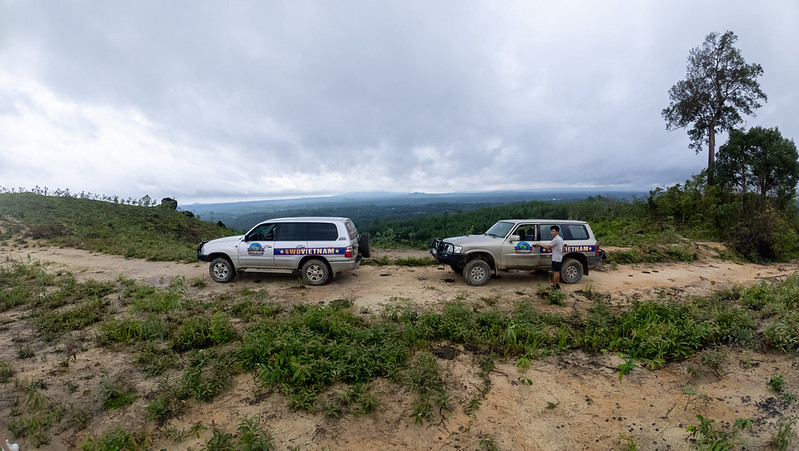
Then I was told that we would drive from Hanoi to Saigon in two 4WD vehicles. We had six days, no hotels booked in advance and a travel fair waiting for us at the end of this journey. Instead of staying on the fastest highways, we would test smaller roads and unfamiliar trails along the way. I felt excited, curious and, if I am honest, slightly nervous. I knew where we were leaving from and where we needed to arrive. Everything in between was uncertain.
Day 1 – The first muddy crossing
At 7:40 a.m., the two vehicles were packed in Hanoi and ready to go. For the first hour, the journey felt almost ordinary: morning traffic, motorbikes, horns and the familiar roads leading out of the capital. Then we turned away from the main route, and the trip changed immediately.

The roads became narrower as we passed through villages between Hanoi and Ninh Bình. Limestone mountains rose behind the rice fields, vegetation closed around us and we began stopping at junctions to decide which road looked worth trying. A digital map might show a clean line, but on the ground that line can be flooded, blocked or barely wide enough for one vehicle. We were about to learn that lesson repeatedly.
Our first obstacle was a large pool of muddy water covering the track. From inside the vehicle, none of us could tell how deep it was. We asked the people living opposite whether it was passable and received an answer that sounded reassuring enough. The first 4WD entered slowly. Brown water climbed around the tires, the cabin went quiet and then the wheels found grip. The vehicle climbed out on the other side, followed by the second car. It was a modest obstacle compared with what came later, but at that moment it felt like our first real victory.
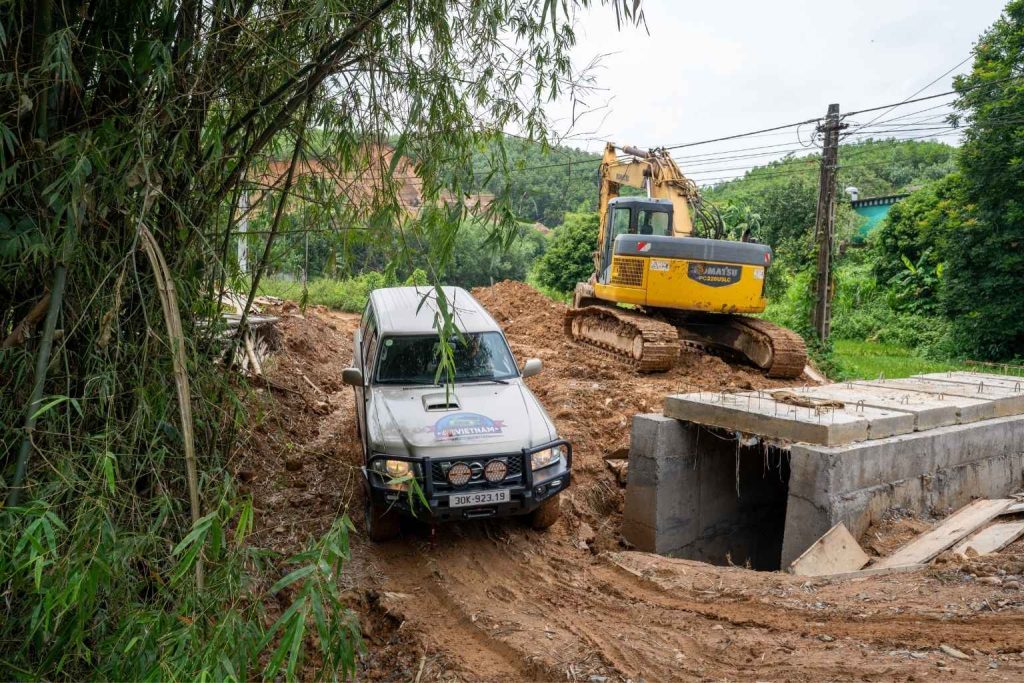
The main road felt too simple after everything we had seen that morning – and, honestly, it was a little boring. Before long, we had turned off again and found ourselves on another small road surrounded by rice fields and thick green vegetation. We stopped several times to take photographs, film the scenery and stretch our legs. Away from the main road, everything felt much quieter. There were no crowds and almost no traffic. Sometimes, it felt as though we had the whole road to ourselves.
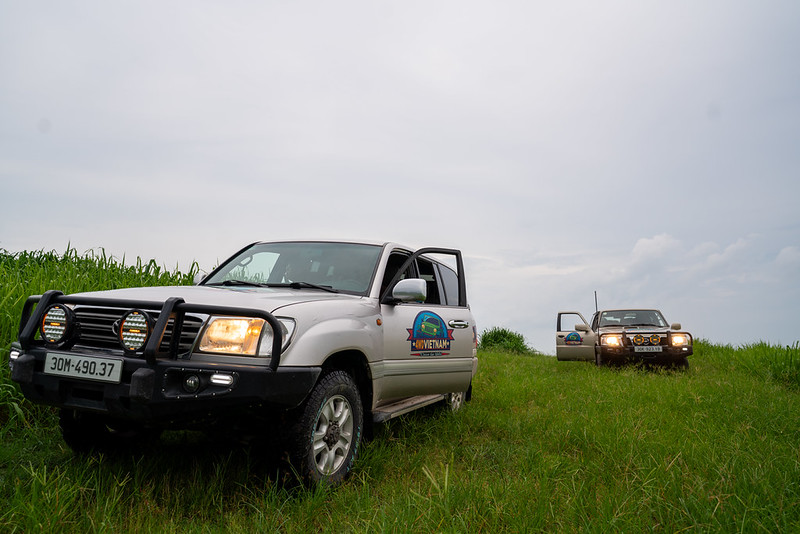
Later, heavy rain turned the windscreen into a grey wall and forced us to stop. When it eased, we continued towards Con Cuông, arriving tired and hungry around 8:00 p.m. The cars were already muddy, the schedule had already stretched, and Saigon still felt impossibly far away.
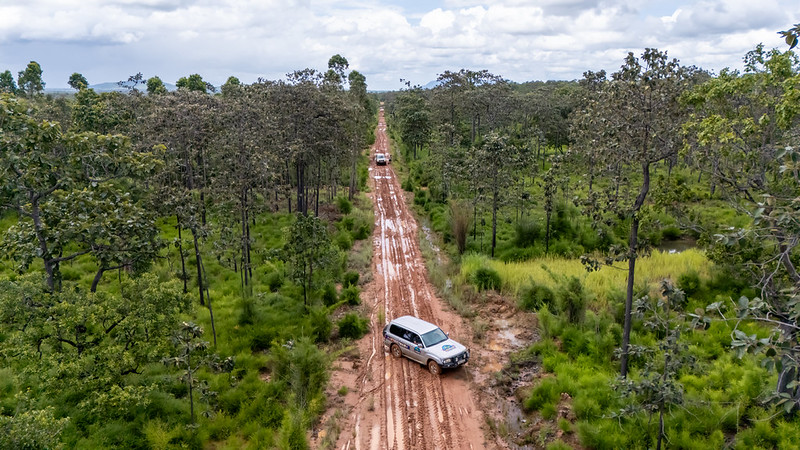
The rain followed us out of Con Cuông. At around 9:00 a.m., we found a narrow rocky trail that appeared to continue for ten kilometres. The beginning was exactly what we had hoped for: tight bends, wet ground, thick vegetation and enough difficulty to make the drive exciting. Inside the vehicles, everyone was talking, filming and imagining how good the route could be.
A few kilometres later, both cars stopped. Several tracks crossed one another and the road seemed to dissolve into the forest. Mr Linh got out, studied the hills and finally launched the drone above the trees. We watched him examine the images on the screen. When he walked back with a serious expression, I knew before he spoke that the news was not good.
Day 2 – The road that disappeared
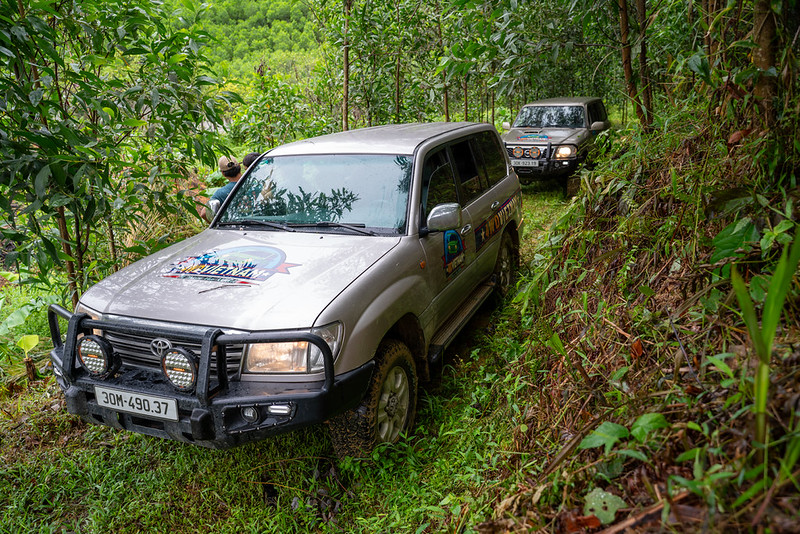
There was no possibility of continuing the road. Going farther could leave two vehicles trapped in a place where turning around would be even harder, so we carefully reversed our plan and followed our own tire marks back through the mud. A local man on a motorbike saw what was happening and began guiding us at each junction. We had phones, maps and a drone, but local knowledge was what finally led us out.
By the time we reached the main road, the cars were covered in mud and we had lost enough time to change the whole day. We spent nearly an hour cleaning them, then continued towards the Trường Sơn mountains near the Lao border. This region formed part of the historic Hồ Chí Minh Trail, the wartime network used to move people and supplies through extremely difficult terrain. Driving through those mountains made the history feel connected to the road beneath us.
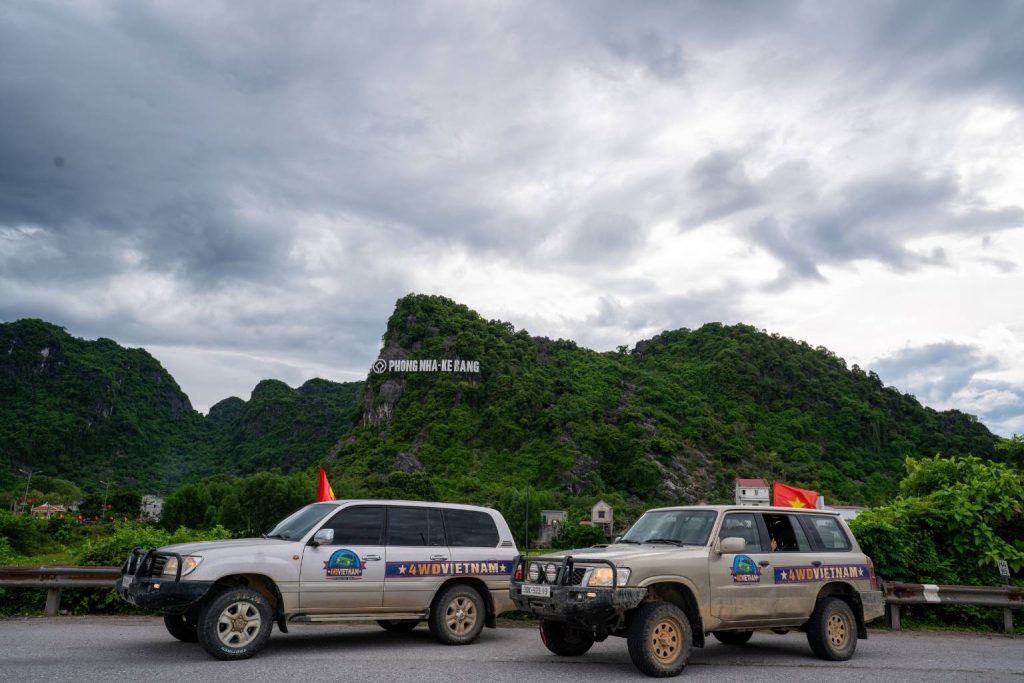
We had planned to reach Khe Sanh, but darkness, rain and endless climbs made that unrealistic. At 7:45 p.m., we changed direction and found a hotel in Đồng Hới. On paper, it was only a new destination for the night. In the cars, it was the result of wet clothes, tired drivers and the decision not to force a difficult road after dark.
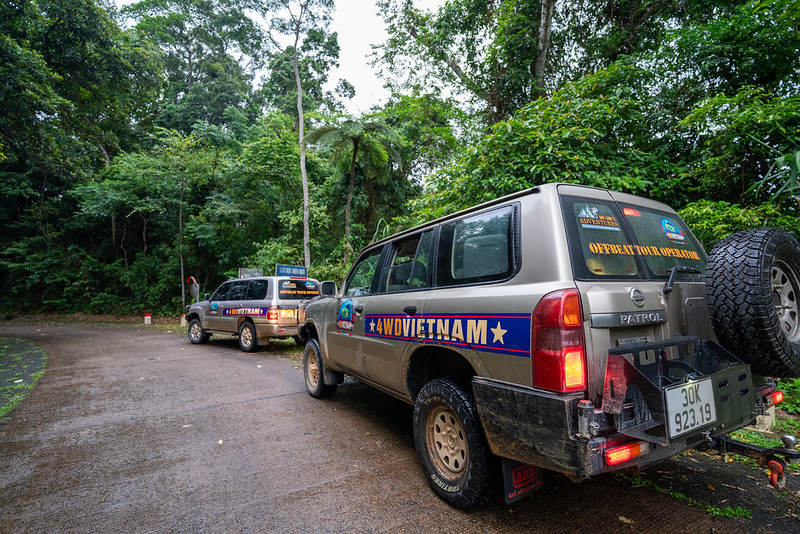
Day 3 – Red earth, buffalo and Khe Sanh
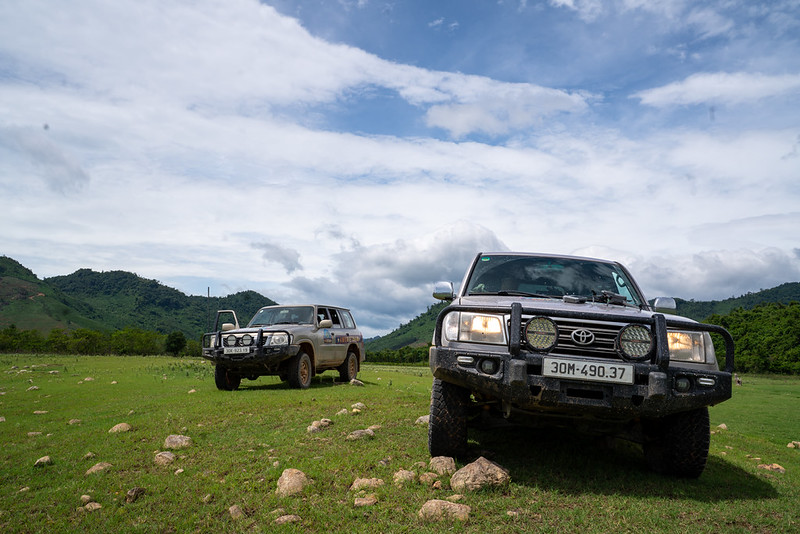
The next morning began with fuel and the usual question: which road looked more interesting than the obvious one? At 9:50 a.m., an orange-red track tempted us away from the highway. After the previous day, I expected another dead end. Instead, the trees opened onto an enormous grassland filled with buffalo.
We stopped the vehicles and stepped out into the silence. After two days of narrow tracks, rain and thick vegetation, the open space felt like a reward. The buffalo showed far less interest in us than we showed in them. There was no famous monument and no marked viewpoint, just a landscape we would never have reached without leaving the main road.
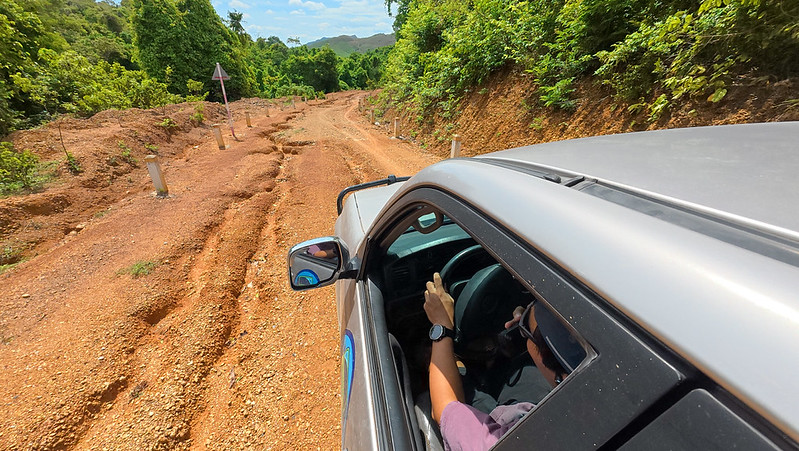
By early afternoon, we reached Khe Sanh and visited the Tà Cơn Airfield relic site, once part of the Khe Sanh combat base. Aircraft and military equipment now stand silently against green hills. Only a few hours earlier, we had been laughing beside the buffalo; now we were looking at reminders of the intense fighting this region endured during the war. Arriving by road, after crossing the same isolated mountain landscape, made the history feel more immediate.
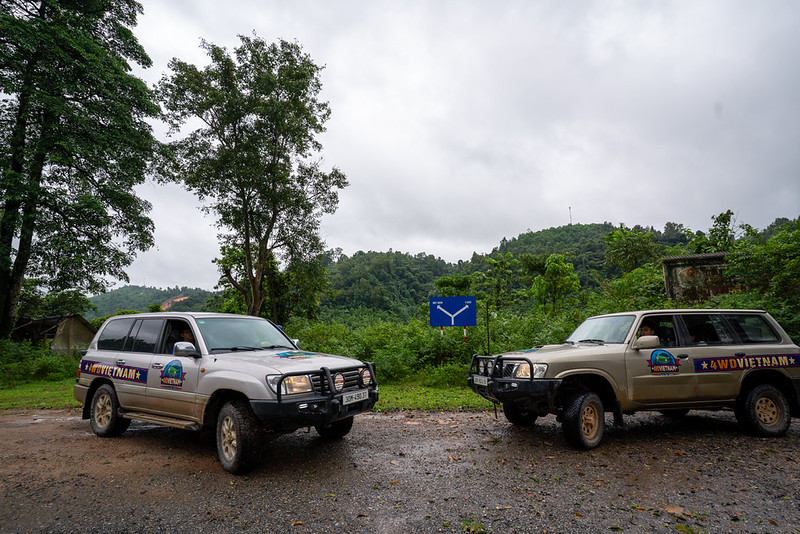
We could have turned towards Huế, but our route continued south through the border country towards La Lay. By then, the two 4WDs had become more than transport. They were our shelter from the rain, our equipment room, our dining room on rushed days and the only reason we could keep following roads whose condition changed without warning.
Day 4 – Nine kilometres of pure driving pleasure
We left La Lay at 7:00 a.m. with a long mountain drive ahead. The sensible choice was to stay on the asphalt. Ten minutes after breakfast, we were searching for another trail.
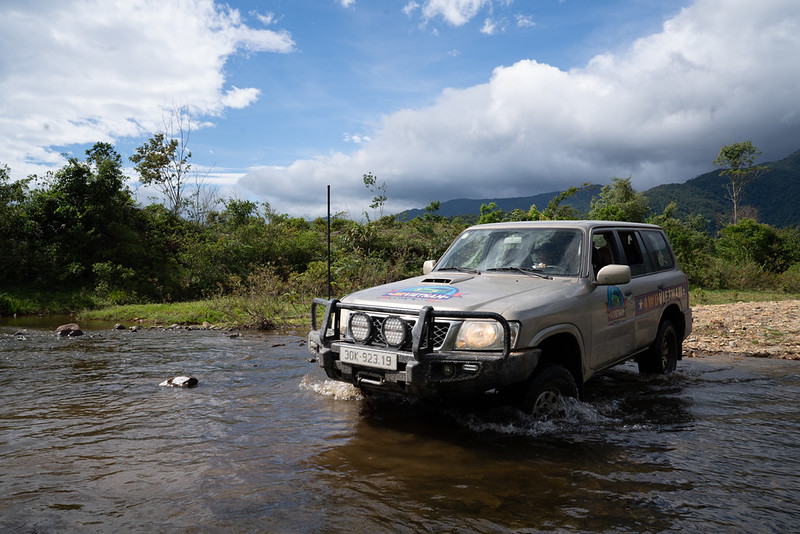
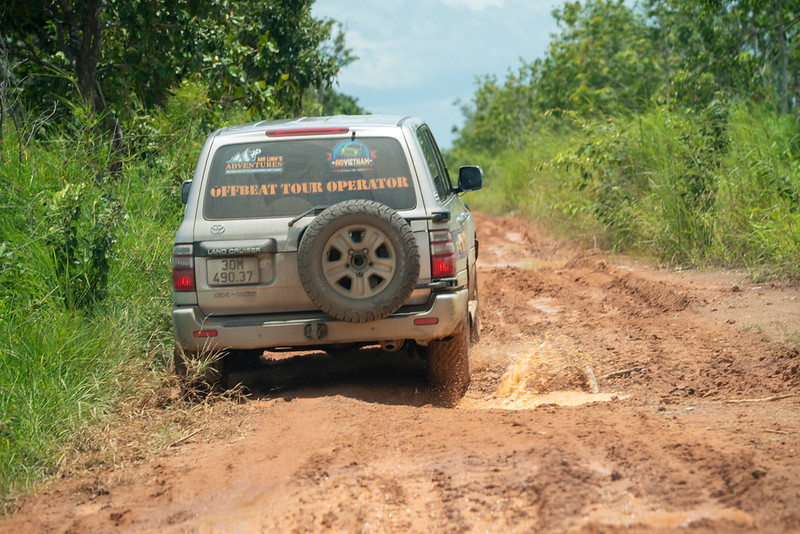
At 8:10 a.m., we found one of the best off-road sections of the trip. Unlike the trail near Con Cuông, this road remained open and readable. It offered bends, climbs, changing surfaces and a stream crossing, but never gave us the feeling that we had pushed too far. The vehicles could work, the drivers could enjoy themselves and everyone inside could relax enough to laugh.
The trail lasted about nine kilometres. That distance sounds short on a highway, but off-road you feel every change in the ground and every movement of the vehicle. For once, there was no dead end, no drone and no difficult retreat. The road itself was the destination, and I was genuinely disappointed when we rejoined the asphalt.
The rest of the day was a long series of climbs and descents near the Lao border. Coffee plantations and straight rows of rubber trees began appearing across the hills, telling us that we had entered the Central Highlands before any road sign did. We reached our overnight stop after dark, exhausted but still talking about those nine kilometres.
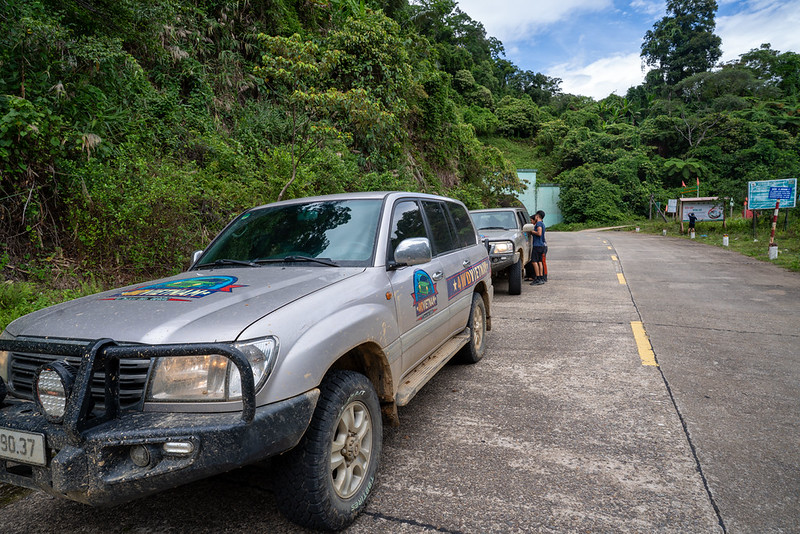
Day 5 – A gate, deep ruts and a flat tire
At 6:15 a.m, under another grey sky, we set out to explore the plantations around the Sê San River basin. In a rubber forest, pale trunks stood in perfect rows, each cut diagonally so that latex could drip into a small cup. Thirty minutes later, we found a muddier track leading into the forested hills.
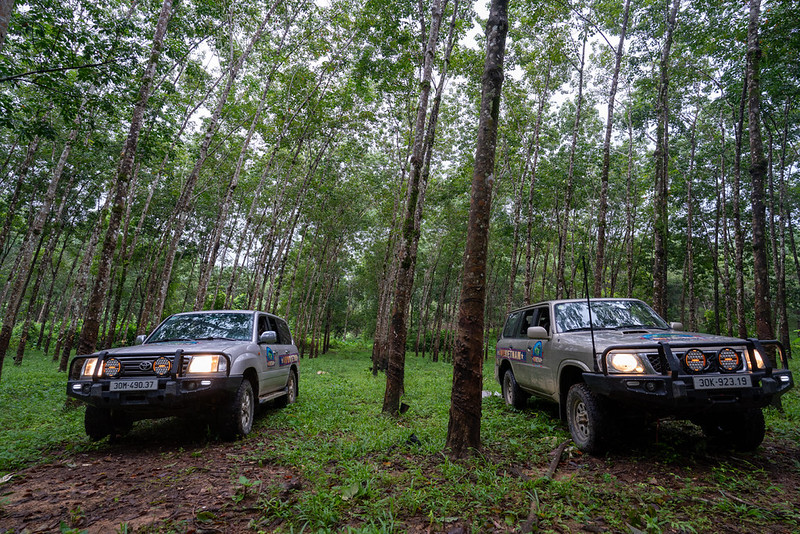
Then a wooden gate tied together with wire blocked the road completely. For at least thirty minutes, we searched for another way through, but there was none. We carefully dismantled the gate, moved both vehicles through and put it back as well as we could. We also left money for the local people as compensation. It was not an obstacle we had expected, but by Day 5 unexpected problems had become part of the rhythm.
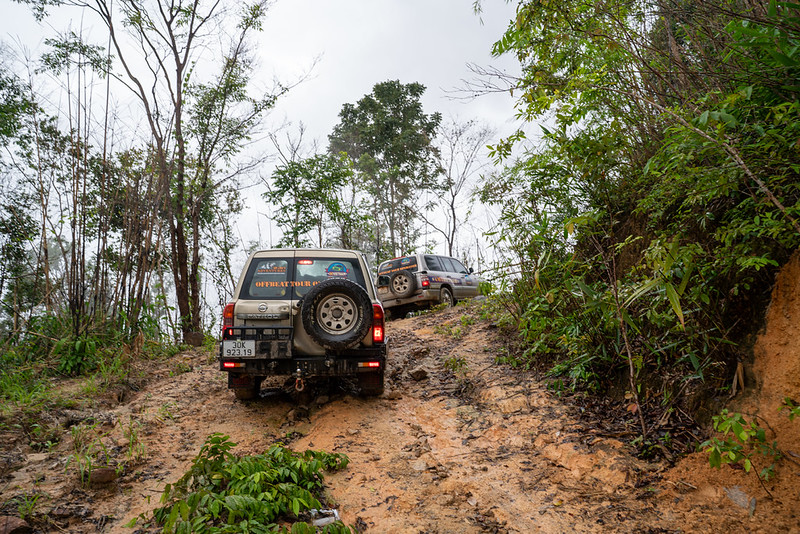
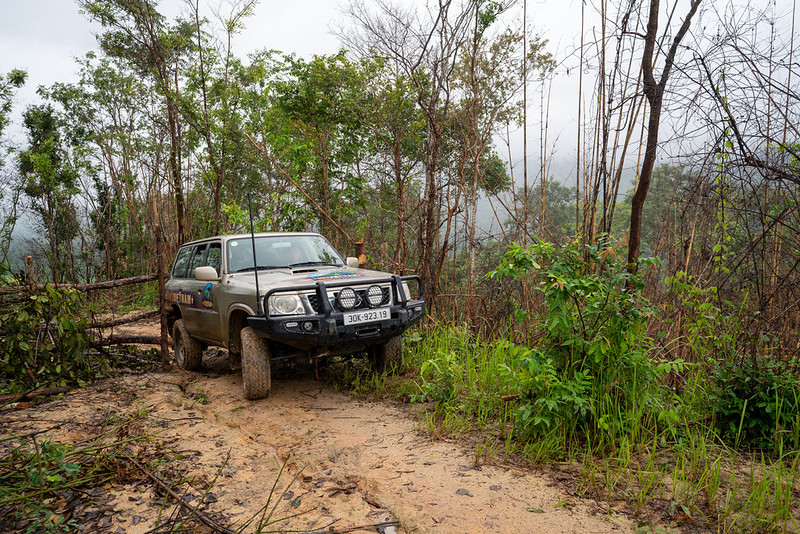
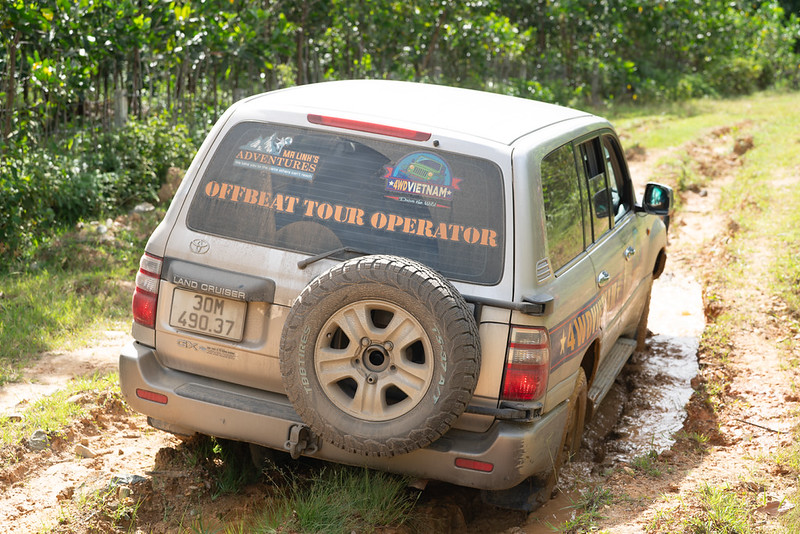
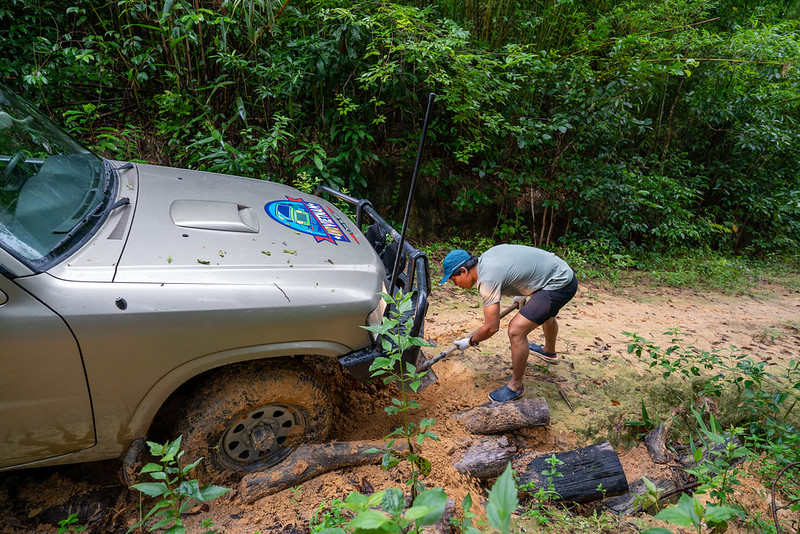
Just before 9:00 a.m., the trail became more serious. Deep muddy holes forced the first car to lean so far to one side that I was genuinely afraid we might tip over. Mr Linh remained calm, chose his line carefully and brought us through. He then got out and guided the second driver, showing exactly where to place the wheels. Watching from outside, I understood how much of off-road driving is not about speed or force. It is about reading the ground and staying patient.
Minutes later, the engines stopped and we boarded a small boat across a reservoir. After days of rain on the roof, tires in mud and constant road noise, the silence felt almost strange. We reached a fishing village where homes and working boats followed the rhythm of the water. We could not stay long, but the pause reminded me that the vehicles were not separating us from local life; they were helping us reach places we would otherwise never have seen.
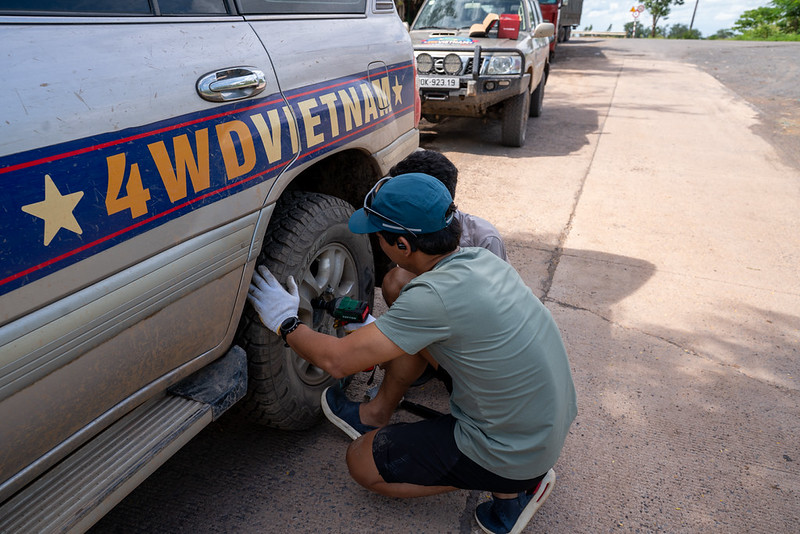
Back on land, we tested another orange trail through a teak plantation, before lunchtime. Then, at around 2:00 p.m., one vehicle suddenly felt wrong. The tire was flat. We unloaded equipment, took out the tools and replaced it beside the road in about thirty minutes. On the first day, it might have felt like a disaster. On Day 5, it was simply another problem to solve before continuing towards Đức Lập.
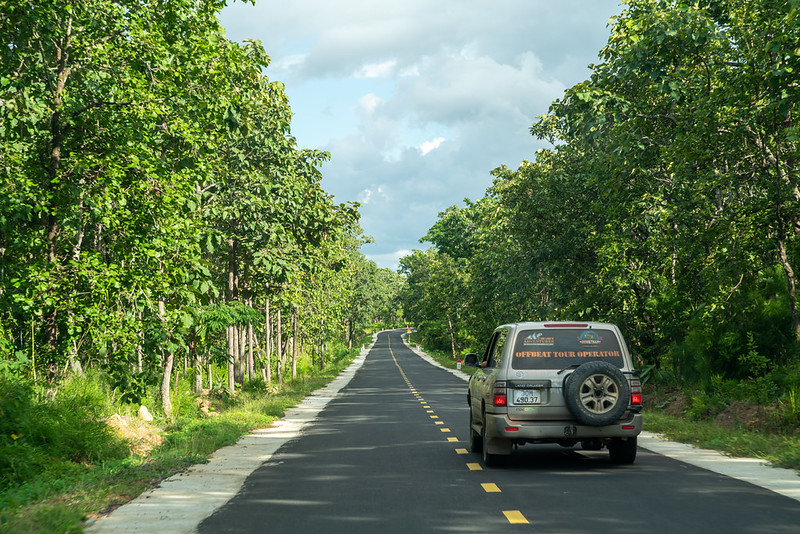
We then continued through the landscape surrounding Yok Đôn National Park, one of Vietnam’s largest protected areas. Stretching along the Cambodian border, the park is known for its dry dipterocarp forest, a rare ecosystem that looks very different from the dense tropical forests I usually associated with Vietnam. Yok Đôn is also an important habitat for wildlife, particularly Asian elephants. Naturally, everyone started watching the trees, hoping that one might appear beside the road. None did, of course. Wildlife rarely follows our schedule, but simply knowing that elephants still moved somewhere within this enormous forest made the drive feel more exciting.
We finally reached Đức Lập at around 5:00 p.m., where our first stop was a tyre shop to replace the damaged tyre. With both vehicles ready for the final day, we found a hotel and enjoyed a well-deserved quiet evening before the last drive to Saigon.
Day 6 – One last maze before Saigon
At 7:50 a.m., after breakfast, coffee and fuel, someone finally said, ‘Let’s go to Saigon.’ Ten minutes later, we left the main road again. By then, I should have expected nothing else.
The track led into a farm filled with coffee, avocado, durian, pepper and palms. There was even a small lake hidden among the fields. We followed one path after another, but every promising option became too narrow or ended among the crops. The plantation slowly turned into a maze. By 8:40 a.m., we had accepted that there was no usable exit and returned to the road.
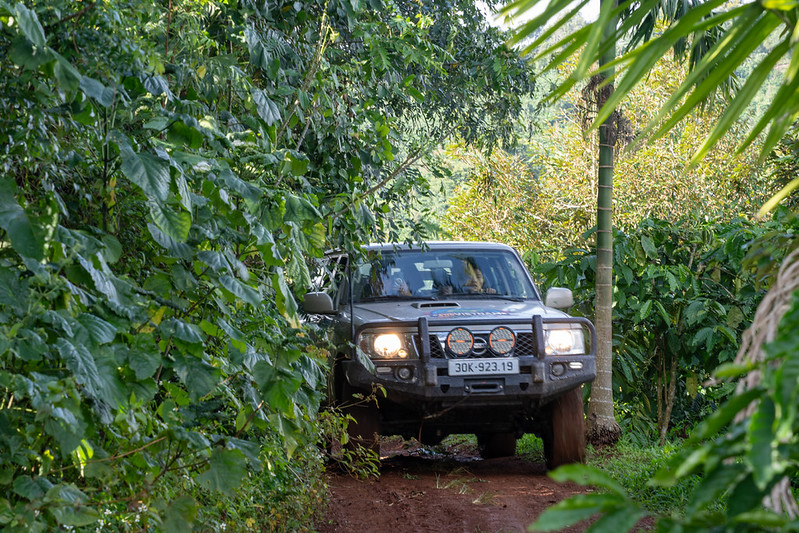
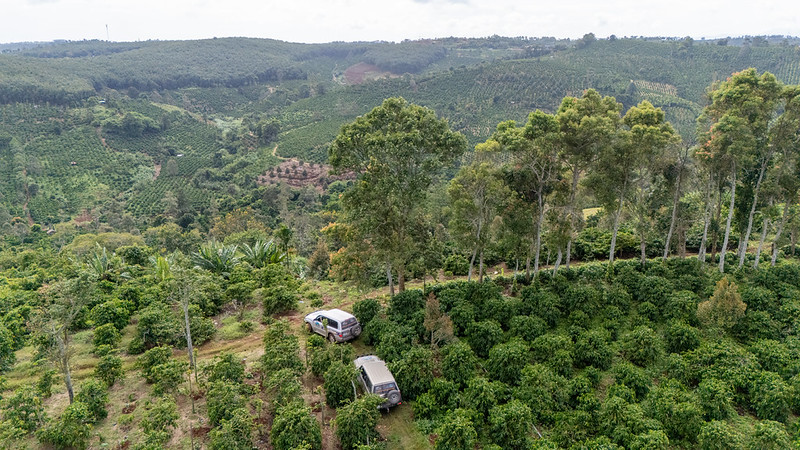
Three minutes later, we tried another route. That small detail probably describes the team better than anything else. A failed track never discouraged us for long. Some roads gave us mud and obstacles; others were easy but led through ginger fields, passion-fruit vines and coffee farms near the Cambodian border. Several led nowhere at all. Testing them was the less glamorous part of scouting, but it was also essential. A line on a map is only a possibility until the wheels have followed it.
After lunch, we finally committed to the last stretch. The temperature rose, palm trees appeared and roadside stalls were piled with durian. Quiet agricultural roads gradually became busier, until motorbikes surrounded both vehicles and Saigon arrived almost all at once.
At around 6:45 p.m., we reached our accommodation. There was no finish line, only two dirty 4WDs, a tired team and the realization that we had crossed from Hanoi to Saigon in six days. The vehicles carried the evidence of the journey: mud around the wheel arches, dust in every corner and equipment that had been unpacked and repacked countless times.
What the road taught us
This journey was never only a test of how far the vehicles could travel. It was a lesson in judgement. We learned when to continue, when to turn around, when to trust the tires and when to get out and study the ground. We learned that the best trail is not always the most extreme one. Sometimes it is the road that is challenging enough to be exciting, but clear enough to let everyone enjoy where they are.
The two 4WDs allowed us to connect places that had previously existed separately in my mind: the mountains near Laos, Khe Sanh, the Central Highlands, rubber forests, coffee farms and the roads approaching Cambodia. They also carried us into conversations, landscapes and quiet villages that would never appear through an aeroplane window.
When I think about those six days, I remember the vehicles leaning through muddy ruts, Mr Linh studying the drone screen, the flat tyre beside the road and the first motorbikes closing around us in Saigon. Some of those moments felt like delays or problems when they happened. Looking back, they were the journey. We reached Saigon, but what stayed with me was everything the road made us work for along the way.